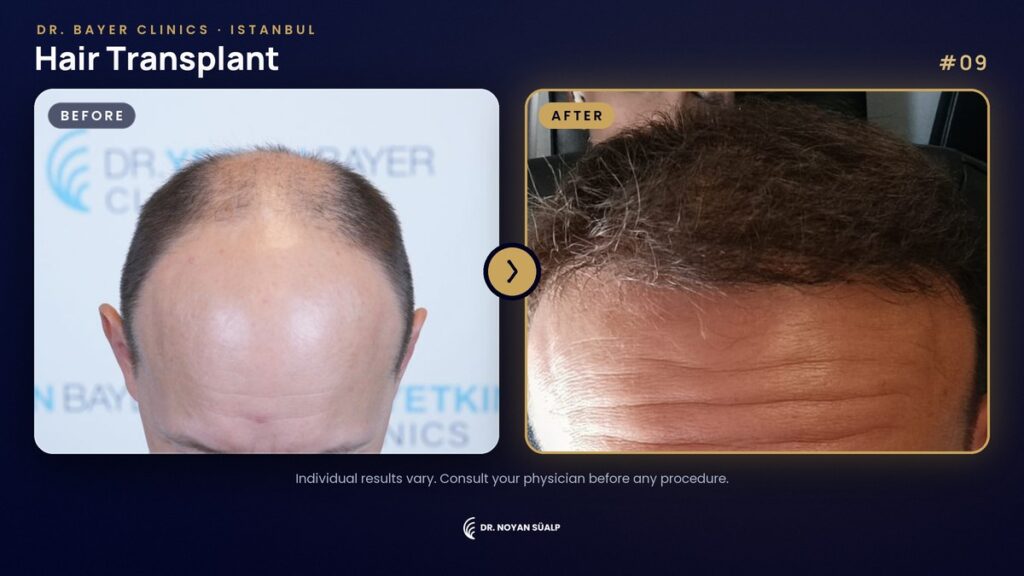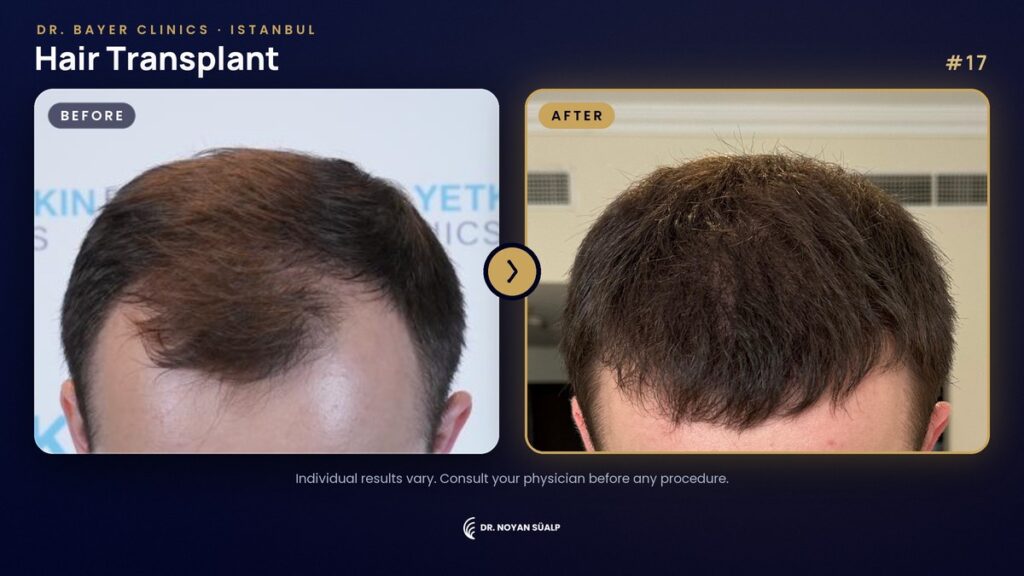

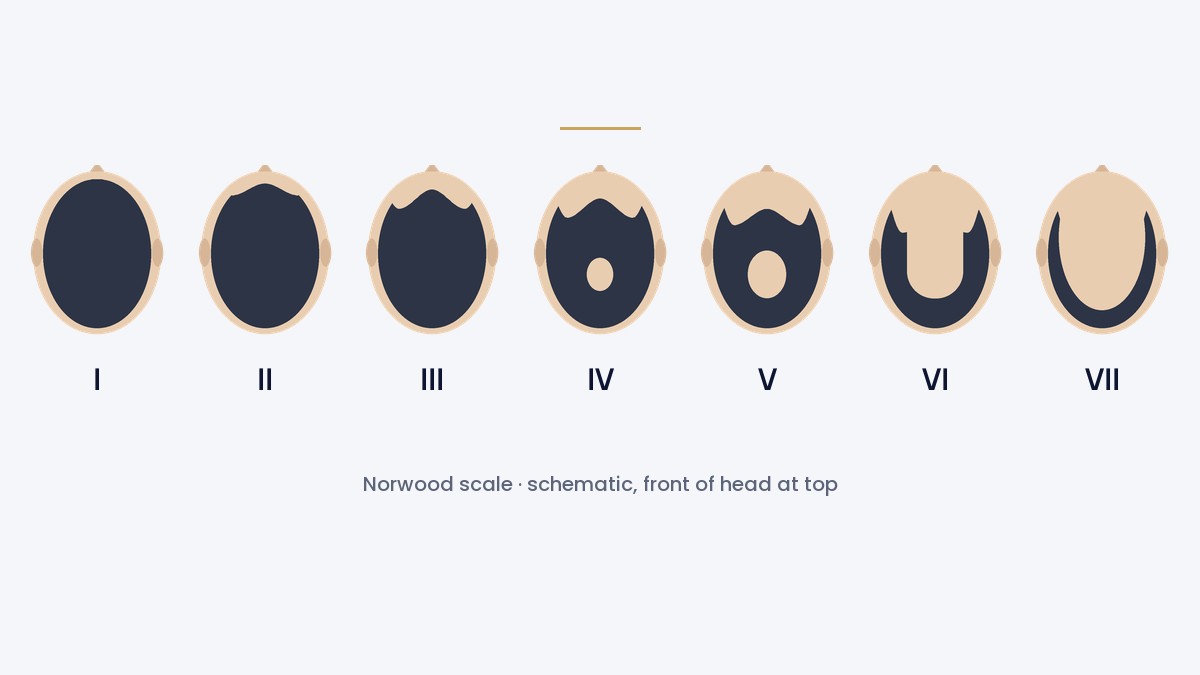
The Norwood scale is the system doctors use to describe how far male pattern hair loss has progressed. It sorts the typical changes, from a slightly higher hairline to a horseshoe of hair around the sides and back, into seven stages. Knowing your stage helps you understand where you are today, what usually comes next and which treatments are realistic for you.
This guide explains each stage with a chart, shows how to work out your own stage from photos, and gives the rough graft ranges that are often discussed at each stage of a hair transplant consultation.
Key points
- The Norwood scale (also called the Hamilton–Norwood scale) has seven stages. Stage I is a full hairline and stage VII is the most advanced loss.
- Stage III is the first stage that is counted as clinical balding. Stage III vertex means the loss is mainly at the crown.
- Hair loss usually moves through the stages slowly, but there is no fixed timetable. Medication can slow it down in many men.
- A hair transplant is planned around your stage, your age and the size of your donor area, not only around the bald area you see today.
What is the Norwood scale?
Male pattern hair loss (androgenetic alopecia) follows a recognisable pattern. In men with a genetic tendency, hair follicles on the top of the head react to dihydrotestosterone (DHT), a hormone made from testosterone. Over time these follicles shrink and produce thinner, shorter hairs until some of them stop producing visible hair. The follicles on the back and sides of the head are much less affected, which is why the “horseshoe” of hair usually remains even in advanced loss.
In 1951 the American anatomist James Hamilton described the types of hair loss he saw in men. In 1975 the American surgeon O’Tar Norwood revised and expanded this work into the classification that is still used today. It has seven main stages, a separate “vertex” variant for stage III and a group of “class A” variants. Doctors use it to record hair loss in a common language, to follow change over time and to plan treatment.
The 7 Norwood stages at a glance
| Stage | What you see | What is usually discussed |
|---|---|---|
| I | A full hairline with no recession, or only a minimal one | No treatment needed |
| II | A slight, even recession at both temples | Monitoring; medication if hair loss runs in the family and shedding is active |
| III | Deeper recession at the temples, bare or sparsely covered | Medication; a hair transplant once the pattern is predictable |
| III vertex | Thinning mainly at the crown, temples no worse than stage III | Medication first; crown transplant in selected cases |
| IV | More frontal loss and a thin or bald crown, still separated by a band of hair | Hair transplant plus medication to protect remaining hair |
| V | Larger front and crown areas, the band between them is thin | Larger hair transplant, front usually given priority |
| VI | The band has gone, front and crown have joined | Planning around the donor area, often in more than one session |
| VII | Only a narrow horseshoe of hair at the sides and back | Realistic, partial coverage; framing the face |
The stages one by one
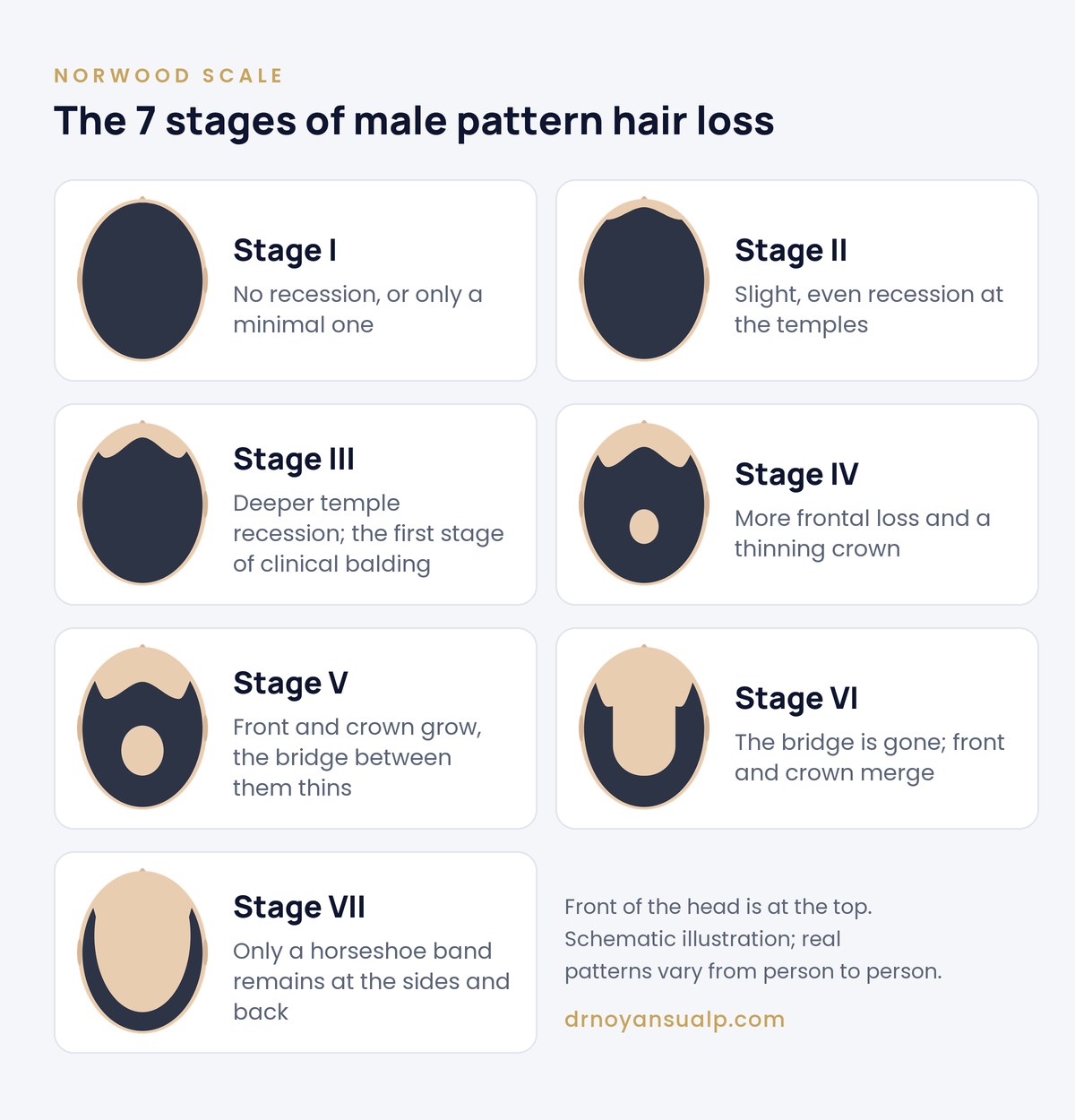
Norwood stage I
There is no noticeable loss. The hairline may sit low and straight, as it does in adolescence. Many men stay at stage I for years and some never move past it.
Norwood stage II
The hairline moves back slightly at both temples, forming small triangular areas. The recession is usually symmetrical and stays well in front of the ears. In many men this is a normal “mature hairline” that develops between the late teens and the thirties, and it does not necessarily mean that further balding will follow.
Norwood stage III
The temples recede more deeply and the skin there is bare or only sparsely covered, which gives the hairline a clear M or U shape. Norwood described stage III as the minimal amount of loss that counts as balding. This is often the stage at which men first look into treatment.
Norwood stage III vertex
Here the main change is at the crown (the vertex), where the scalp starts to show through. The frontal hairline has receded no further than in stage III. Because crown thinning is hard to see in a mirror, many men only notice it in photos taken from above.
Norwood stage IV
The frontal recession is deeper than in stage III and the crown is thin or bald. The two areas are still separated by a band of moderately dense hair that runs across the top of the head and joins the hair on the sides.
Norwood stage V
Both the front and the crown areas are larger. The band of hair that separates them becomes narrower and thinner, so the two areas start to look like one. The remaining hair on the sides and back begins to form a horseshoe shape.
Norwood stage VI
The bridge of hair across the top has gone and the front and crown have merged into one bald area. The loss may also extend further down the sides.
Norwood stage VII
This is the most advanced stage. Only a narrow horseshoe-shaped band of hair remains, starting in front of the ears and running around the back of the head. The hair in this band is often finer and less dense than before.
Norwood class A: the front-to-back pattern
A smaller group of men lose hair in a different way. Instead of recession at the temples and a separate bald spot at the crown, the whole hairline moves backwards evenly from the front, without an island of hair left in the middle. Norwood called these “class A” variants (IIa, IIIa, IVa and Va). Telling them apart matters for planning, because the front of the head is usually the priority and there is no separate crown area to plan for.
How to work out your own Norwood stage
You can get a good idea of your stage at home with a few clear photos:
- Front: stand facing the camera in daylight and pull your hair back from the forehead so the temples are visible.
- Top: ask someone to take a photo from directly above your head, with your hair dry and unstyled.
- Crown: photograph the back of the top of your head, or use your phone’s timer with the camera held above and behind you.
- Sides: one photo of each temple from the side.
Compare the photos with the chart above. Look at how deep the temples go, whether the crown shows scalp and whether a band of hair still separates the two areas. Wet or freshly styled hair and strong overhead light can make thinning look worse than it is, so use natural light and dry hair.
The Norwood scale only describes patterned hair loss in men. If your hair is thinning evenly all over, if you have round bald patches, or if the scalp is red, itchy, scaly or painful, the cause may be different and you should see a doctor. Female pattern hair loss is graded with other systems, such as the Ludwig scale, because it usually spreads over the top of the head while the front hairline is kept.
Rough graft ranges by Norwood stage
A graft (follicular unit) is a natural group of one to four hairs, roughly two on average, taken from the donor area at the back and sides of the head. The ranges below are rough planning figures that are often discussed at each stage. Your own number can be lower or higher.
| Stage | Rough graft range | Notes |
|---|---|---|
| II | 500 – 1,500 | Often not needed; sometimes a hairline refinement |
| III | 1,500 – 2,500 | Hairline and temples |
| III vertex | 1,000 – 2,000 | Mainly the crown |
| IV | 2,500 – 3,500 | Front and mid-scalp, crown depending on the donor area |
| V | 3,500 – 4,500 | Front first, crown in the same or a later session |
| VI | 4,500 – 6,000 | Often two sessions; limited by the donor area |
| VII | 5,000 and more | Full coverage may not be possible; the front is prioritised |
The exact number depends on several things:
- Donor density and size: how many grafts can be taken safely without leaving the back of the head visibly thin.
- Hair calibre, colour and texture: thick, wavy or curly hair covers more scalp per graft than fine, straight hair. Low contrast between hair and skin colour also helps.
- The area you want to cover and the density you expect in it.
- Your age and expected future loss: younger men need a plan that still looks natural if the hair behind the transplanted area thins later.
Because the donor area is limited, a good plan decides where the grafts give the most visible benefit. For most men this is the hairline and the front half of the scalp, which frame the face.
Treatment options at each stage
Stages I and II
Treatment is usually not needed. If hair loss runs in the family and you notice more shedding, a doctor can discuss medical treatment early, when there is still more hair to keep. Hair transplantation is rarely advised at this stage, especially in young men whose final pattern is not yet clear.
Stages III and III vertex
This is when many men start treatment. Topical minoxidil and oral finasteride are the medicines with the strongest evidence for male pattern hair loss. Both have been shown in clinical trials to slow loss and improve hair counts compared with placebo, although they work only while they are used. Finasteride is a prescription medicine and its benefits and possible side effects should be discussed with a doctor. A hair transplant can rebuild the hairline once the pattern is predictable, with a design that suits your age.
Stages IV and V
A transplant is usually the main option for restoring the front and the top. Medication is often recommended alongside it, because the transplant does not stop the remaining native hair from thinning. Depending on the donor area, the crown can be treated in the same session or later. Techniques such as FUE and DHI both use grafts taken one by one from the donor area; the difference is in how they are implanted.
Stages VI and VII
The bald area is large and the donor area is relatively small, so the plan focuses on what will make the biggest visible difference: usually a natural hairline and coverage of the front and mid-scalp. Large sessions may be split in two. In some men, beard hair can add to the donor supply. Honest expectations are important; complete coverage of the whole scalp is often not possible.
Can you stop hair loss moving to the next stage?
Male pattern hair loss tends to progress, but the speed differs a lot from person to person and it does not move through the stages at a fixed rate. Medical treatment can slow or stabilise it in many men, and some regain part of the hair in thinning areas, especially at the crown. Bare temples that have been bald for years rarely recover with medication alone.
A hair transplant moves follicles that are resistant to hair loss into the thinning areas, but it does not change the behaviour of the native hair around them. That is why your doctor will look at your family history and age, and may suggest medication to protect the hair you still have. You can read more in our article on whether a hair transplant is permanent.
Frequently Asked Questions
What Norwood stage is a receding hairline?
A slightly receding hairline is usually stage II. When the temples recede deeply and the skin there is bare or nearly bare, it is stage III, which is the first stage counted as clinical balding.
Is Norwood 2 considered balding?
Not necessarily. Many men develop a slightly higher, more mature hairline in their twenties and stay at stage II. It is worth monitoring with photos every six to twelve months, especially if hair loss runs in your family.
What is Norwood 3 vertex?
Norwood 3 vertex means the hair loss is mainly at the crown, while the frontal hairline has receded no more than in stage III. Crown thinning often responds better to medication than a receding hairline does.
Can you get a hair transplant at Norwood 7?
Sometimes, but the goal is different. At stage VII the donor area is usually not large enough to cover the whole scalp, so the plan focuses on a natural hairline and the front of the head. A doctor needs to examine the donor area before saying what is realistic.
How fast does hair loss move from one Norwood stage to the next?
There is no fixed timeline. Some men stay at the same stage for many years, while others progress within a few years. Age of onset and family history give some clues, and medication can slow the process.
Does the Norwood scale apply to women?
No. Female pattern hair loss usually causes diffuse thinning over the top of the head while the front hairline is kept, so it is graded with scales such as the Ludwig scale. See our page on hair transplant for women for more information.
Which Norwood stage is best for a hair transplant?
There is no single best stage. Stages III to V are the most common at consultation, because the pattern is usually clear and the donor area can still cover the main areas. The right timing depends on your age, how stable your hair loss is and your expectations.
Sources
- Hamilton JB. Patterned loss of hair in man; types and incidence. Ann N Y Acad Sci. 1951;53(3):708–728. PubMed
- Norwood OT. Male pattern baldness: classification and incidence. South Med J. 1975;68(11):1359–1365. PubMed
- Ludwig E. Classification of the types of androgenetic alopecia (common baldness) occurring in the female sex. Br J Dermatol. 1977;97(3):247–254. PubMed
- Kaufman KD, Olsen EA, Whiting D, et al. Finasteride in the treatment of men with androgenetic alopecia. J Am Acad Dermatol. 1998;39(4 Pt 1):578–589. PubMed
- Olsen EA, Dunlap FE, Funicella T, et al. A randomized clinical trial of 5% topical minoxidil versus 2% topical minoxidil and placebo in the treatment of androgenetic alopecia in men. J Am Acad Dermatol. 2002;47(3):377–385. PubMed
- Gupta AK, Venkataraman M, Talukder M, et al. Relative efficacy of minoxidil and the 5-α reductase inhibitors in androgenetic alopecia treatment of male patients: a network meta-analysis. JAMA Dermatol. 2022;158(3):266–274. PubMed
- Jimenez F, Alam M, Vogel JE, et al. Hair transplantation: basic overview. J Am Acad Dermatol. 2021;85(4):803–814. PubMed
- NHS. Hair loss. nhs.uk
- American Academy of Dermatology. Hair loss: diagnosis and treatment. aad.org
Further reading: Before and after results
Not sure which stage you are? Send a few photos through our online hair analysis form or message us on WhatsApp, and Dr. Noyan Süalp’s team will get back to you with a first assessment.
This article is for general information and does not replace a medical examination. Only a doctor who has examined you can recommend the right treatment. Individual results vary.