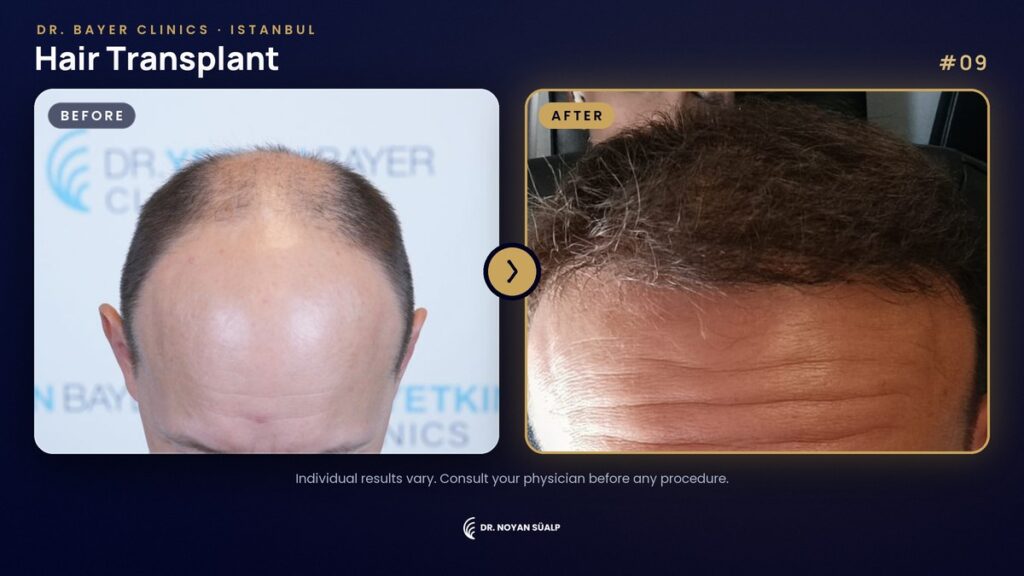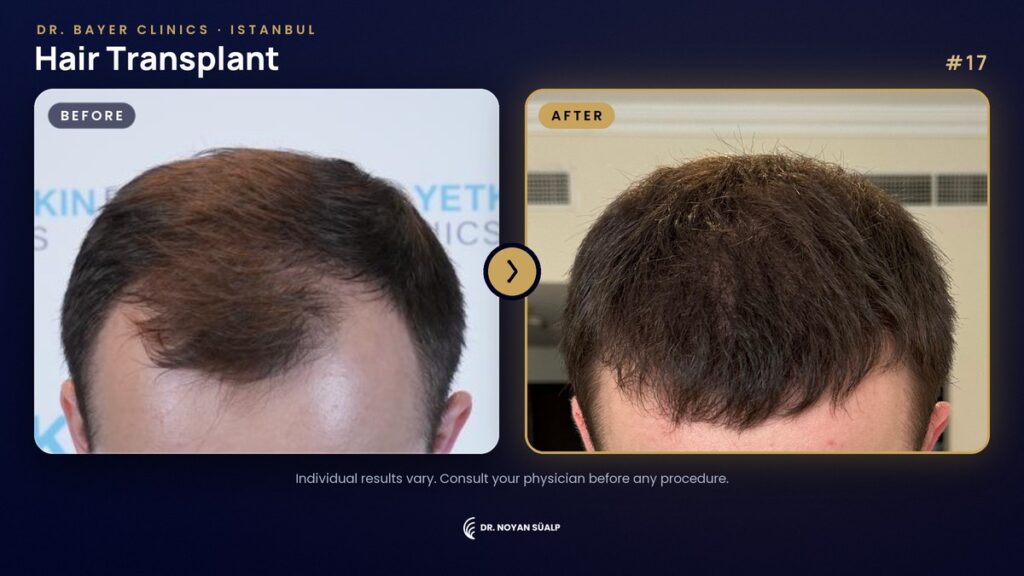

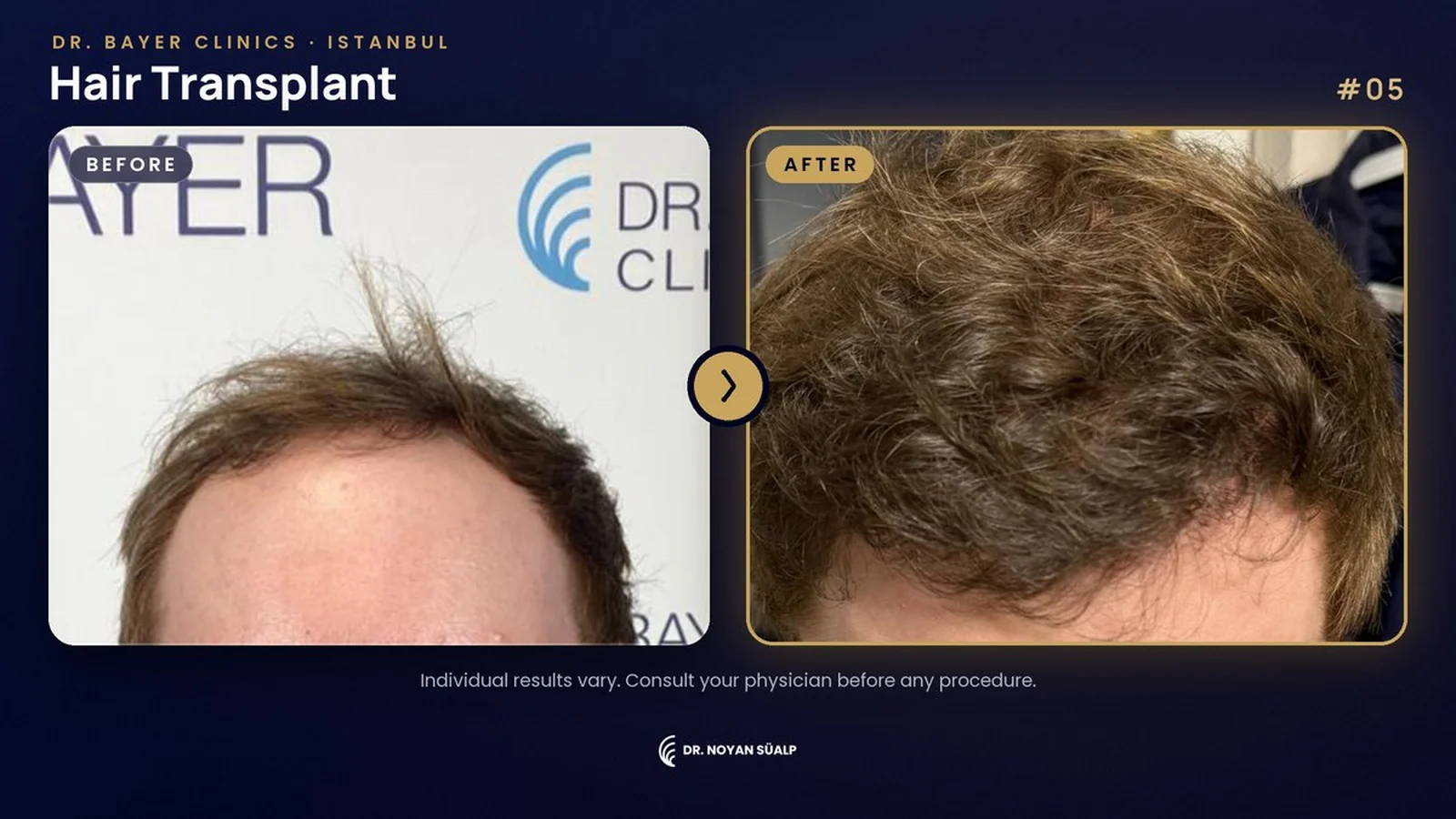
In this case the hair transplant focused on the frontal hairline and the front of the scalp. In the “before” photo the temples have receded and the skin of the front is clearly visible through thin hair; in the “after” photo the front is covered with dense hair and the hairline sits lower. In this article I comment only on what the photos show and explain in general terms how a frontal hairline is planned. Individual results vary.
At a glance
- Area: frontal hairline, temples and front of the scalp.
- Before: receded temples, thin hair at the front, visible scalp.
- After: the front is covered and the hairline is lower and more even.
- Note: the photos were taken in different places, from slightly different angles, and the hair is longer in the “after” photo.
- The photos are published with the patient’s consent and have not been retouched.
What the photos show
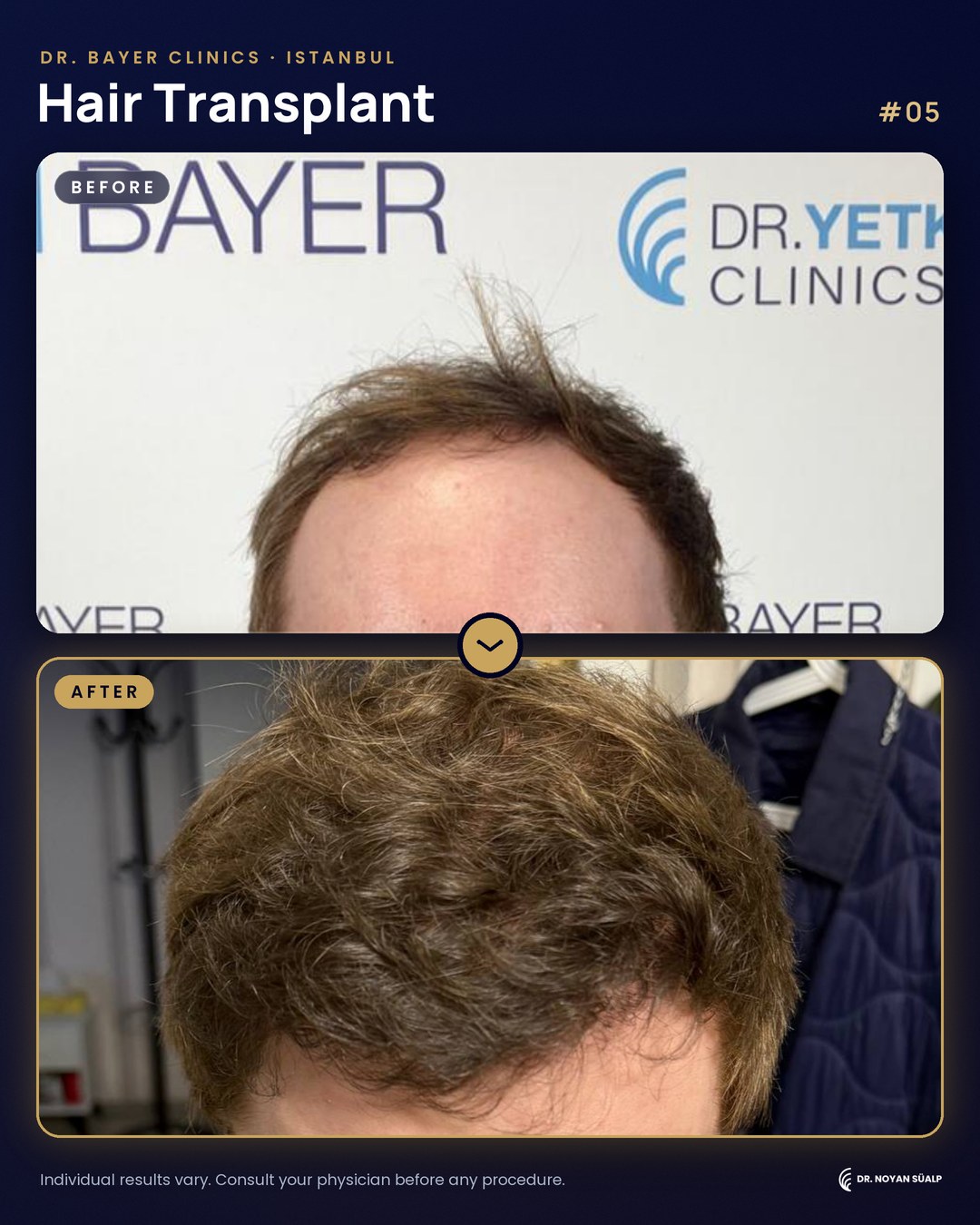
The “before” photo was taken in the clinic, from the front. Both temples have receded, the hairline is high and irregular, and the hair across the front is thin enough for the scalp to show through.
The “after” photo was taken somewhere else and from slightly higher up. The front of the scalp is covered with dense, wavy hair, the temple corners are no longer deep, and the scalp is not visible through the front. The hair is longer and styled, which also affects how full it looks.
How to read before and after photos honestly
Several things can change the impression of a before-and-after photo:
- Light: strong overhead light makes the scalp shine and hair look thinner; softer light does the opposite.
- Length and styling: longer, wavy hair covers more scalp than short, straight hair with the same number of follicles.
- Angle: a photo taken from above shows the front differently from a straight frontal photo.
- Setting: different backgrounds and cameras change colour and contrast.
None of this makes a result less real, but it is the reason it helps to look at several cases and at photos taken in standard conditions, not at a single picture. You can see more cases in our before and after gallery.
How a frontal hairline is planned
The frontal hairline frames the face, so it is the part of a hair transplant that people notice first. Planning it means considering several things together:
- Face and age: a hairline that suits a man in his twenties can look out of place twenty years later. A position that will still look natural as the face matures is usually the safer choice.
- Future hair loss: pattern hair loss can continue behind the transplanted area. The plan has to leave room for that, both in design and in the use of the donor area.
- Donor supply: follicles taken from the back and sides of the head do not grow back there. Every graft used at the front is a graft that cannot be used later elsewhere.
- Natural details: a natural hairline is slightly irregular, starts with single-hair grafts and follows the direction in which hair grows at the front.
The planned line is usually drawn on the skin before the procedure and checked together with the patient in the mirror. It is easier to adjust a line drawn with a marker than to change a hairline later. If you are planning a procedure, ask the clinic who will draw your hairline and when you can review it.
What this case does not tell us
I do not give a graft number, a hair loss stage or the time between the photos here. These cannot be read reliably from a photograph, and every plan is based on an individual examination. Two hairlines that look similar can need very different numbers of grafts, depending on hair thickness, curl, donor density and how far the hair loss is likely to progress.
Who this case is not similar to
- people with very advanced hair loss and a limited donor area, where full coverage of the front and crown may not be possible;
- women with diffuse thinning, which is planned differently (see hair transplant for women);
- patchy hair loss such as alopecia areata, where a transplant is usually not the first option;
- very young patients whose hair loss is changing quickly, where we often wait or start with medical treatment first.
Is a result like this possible for you?
That depends on your donor area, your hair type and how your hair loss is likely to develop, which is why the first step is an assessment rather than a promise. Hair transplantation moves your own follicles; it does not create new ones. Transplanted hair usually keeps growing for years, but your native hair can continue to thin, as I explain in is a hair transplant permanent? More about the procedure itself: FUE hair transplant.
Frequently Asked Questions
How long does it take to see the result of a hairline transplant?
New hairs usually start to appear after three to four months. The front often fills in earlier than the crown, but the final result is judged at around twelve months or later.
Will my new hairline look natural?
A natural look depends mainly on design: an age-appropriate position, single-hair grafts at the very front and the correct angle and direction. These are planned before the procedure and discussed with you.
Can the hairline and temples be treated in one session?
Often yes, if the donor area allows it. The final decision depends on how many grafts the plan needs and how much donor supply you have.
Sources
- Jimenez F, Alam M, Vogel JE, et al. Hair transplantation: basic overview. J Am Acad Dermatol. 2021;85(4):803–814. PubMed
- Goldin J, Zito PM, Raggio BS. Hair transplantation. In: StatPearls. StatPearls Publishing; 2025. PubMed
Further reading: Before and after results · Norwood scale · Recovery timeline
Want to know what is realistic for your hairline? Send a few photos through our online hair analysis form or message us on WhatsApp. More about the procedure: hair transplant in Istanbul.
The photos are published with the patient’s consent and have not been retouched. This article is for general information and does not replace a medical examination. Individual results vary.