

Cover image generated with AI.
A hair transplant is done under local anaesthesia and usually takes most of the day. The day starts with a final consultation and the design of your hairline, continues with the removal of follicles from the donor area, a break, and then the placement of the grafts in the thinning area. You are awake throughout; the most uncomfortable moment is the local anaesthetic injections, after which most people feel pressure and touch rather than pain.
In this guide I walk you through a typical procedure day step by step: what usually happens, roughly how long each stage takes and what you are likely to feel. Times depend on the number of grafts, the technique and the way each clinic organises its day.
At a glance
- The procedure is done under local anaesthesia; general anaesthesia is not usually needed.
- The day has four main parts: planning, graft extraction, a break and graft placement.
- A session often takes several hours, and a large session can take the whole day.
- The anaesthetic injections are the most uncomfortable part; if sensation returns, the anaesthetic is topped up.
- You go back to your hotel the same day and sleep with your head raised on the first night.
The evening before and the morning of the procedure
Try to sleep well and avoid alcohol the night before. In the morning, wash your hair with your usual shampoo, do not use any styling products, have a light breakfast and wear a shirt that buttons or zips at the front so that nothing has to be pulled over your head afterwards. Take your regular medicines as usual unless your doctor has told you otherwise, and bring a list of everything you take.
A full-day session, hour by hour
The table below shows how a full-day session might run. The clock times are only an example; smaller sessions are shorter, and every clinic plans its own day.
| Example time | Stage | What happens | What you feel |
|---|---|---|---|
| 08:30 | Arrival and final consultation | Review of the plan, consent form, photos and any tests the clinic requires | Nothing; this is the time to ask questions |
| 09:30 | Hairline design | The hairline and treatment area are drawn on the skin and checked together in the mirror | Nothing |
| 10:00 | Preparation and local anaesthetic | The donor area is trimmed and cleaned, then numbed | Stinging during the injections for a few minutes |
| 10:15–13:00 | Graft extraction | Follicles are removed one by one with FUE | Pressure and the sound of the instrument |
| 13:00 | Lunch break | Food, toilet, a short walk | Some stiffness from lying still |
| 14:00 | Anaesthetic of the recipient area | The area to be treated is numbed | Stinging during the first injections |
| 14:15–17:00 | Graft placement | Channels are opened and grafts placed, or grafts are implanted directly with DHI | Pressure and light touch |
| 17:00 | Dressing and instructions | Donor dressing, medicines and written aftercare instructions | Tightness and tiredness |
Arrival and final consultation
When you arrive, the plan is usually reviewed with you once more: which areas will be treated, what you expect, which medicines you take and how you feel that day. Please ask every question you have at this stage. You read and sign the consent form, and photos are taken before anything else happens. Depending on the clinic, some blood tests may also be done on the day.
Designing the hairline
This is one of the most important moments of the day. The hairline is usually planned by the doctor together with you and drawn on the skin with a marker, taking into account the shape of your face, your age, how your hair loss may progress in the future and how much donor hair you have. You then look at it together in the mirror and it is adjusted if needed. A very low, straight line may look attractive today but may not look natural in twenty years, so this step should not be rushed. Ask the clinic in advance who will draw your hairline and when you can review it.
Preparing the donor area
The donor area is usually the back and sides of the head. With standard FUE this area is trimmed short. With an unshaven hair transplant only narrow strips are trimmed, or none at all, which can make the procedure longer.
Local anaesthetic: will it hurt?
This is one of the most common questions, and the honest answer is that the injections of local anaesthetic are the most uncomfortable part. The medical literature on pain control in hair transplantation says the same: most of the pain associated with the procedure comes from the injection of the anaesthetic. This stage lasts a few minutes, and there are ways to make it more comfortable, for example injecting slowly and in stages. Once the area is numb, most people feel only pressure and touch.
During a long session the anaesthetic can wear off. If you start to feel more than pressure, tell the team straight away and the area will be numbed again. You are not expected to put up with pain.
Graft extraction
During extraction you usually lie face down or on your side. The follicles are removed one by one with a small punch and kept cool in a storage solution until they are placed. The time grafts spend outside the body, keeping them moist and handling them gently are among the basic factors that affect how well they survive, so this stage needs organised, careful work. Many patients listen to music, talk or doze during this part.
The break
There is usually a break between extraction and placement. You eat, use the toilet and walk around a little. You can also ask for short breaks at other times: lying still for a long time is tiring, and it is perfectly fine to say so.
Graft placement
The recipient area is numbed as well. With FUE, small channels are opened first and the grafts are placed into them; with DHI the grafts are implanted directly with a special pen. You usually lie on your back or sit reclined. The angle and direction of each hair matter a great deal for a natural result, so this is not a stage to hurry. You can compare the techniques in my guide to FUE vs DHI.
Dressing and instructions
At the end, a dressing is usually placed over the donor area and the treated area is often left uncovered. You receive written instructions for the first days: medicines, how to wash, how to sleep and what not to touch. Read them again before you leave and ask about anything that is unclear.
What you can do during the procedure
- talk, listen to music or podcasts, or watch something;
- ask for a break or the toilet at any time;
- tell the team straight away if you feel thirsty, cold or uncomfortable;
- ask where you are in the process; knowing what comes next often helps people relax.
What to bring
- your passport or ID;
- a list of your medicines and the medicines themselves;
- previous test results, if you have them;
- a shirt that buttons at the front and comfortable shoes;
- a phone charger and headphones;
- a travel neck pillow for the first nights.
The first hours and the first night
When the anaesthetic wears off, the donor and recipient areas may feel tight or sore. This is usually controlled with the pain relief your doctor recommends. On the first night, sleep with your head raised, for example on two pillows or with a neck pillow. Do not touch the grafts, keep them away from the pillow and avoid bending forward. Swelling of the forehead is common in the following days and usually settles within a week.
If you were given a sedative, do not drive. Going back to the hotel with the clinic’s transfer, if there is one, or with a companion is easier. What happens next is explained in my hair transplant recovery timeline.
What matters most on the day from a medical point of view
For the patient the day is long and a little tiring. From a medical point of view, a well-planned day is built around a few key points: confirming the hairline with the patient one last time, taking grafts from the donor area in a way that protects its future supply, keeping the time grafts spend outside the body short and placing every hair in its natural direction. The patient’s comfort is part of the plan too: breaks, topping up the anaesthetic in time and explaining each step.
If you are travelling to Istanbul
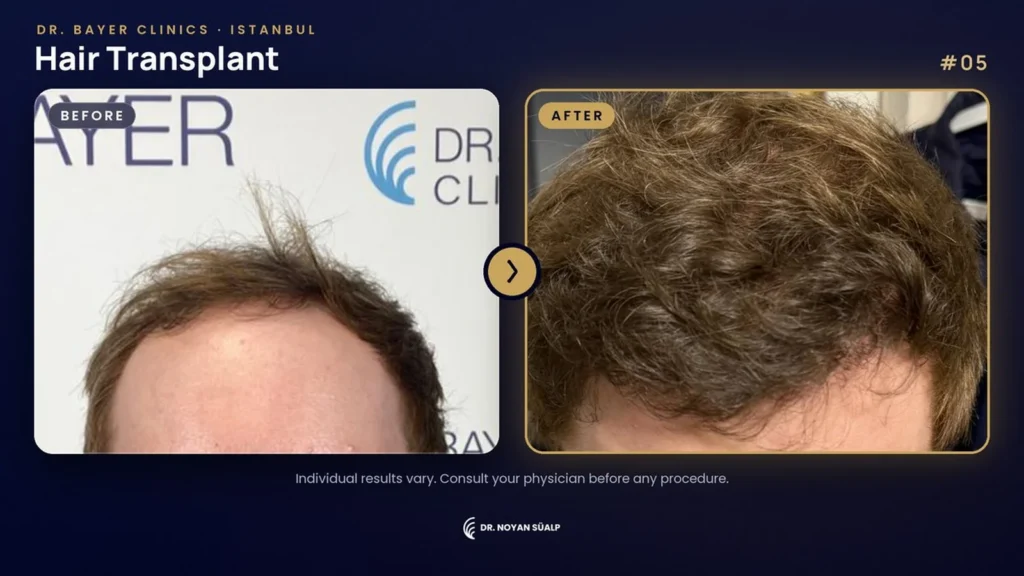
It is easier to arrive the day before the procedure. Book your flight home according to the clinic’s plan for the first check-up and wash. You can read more about planning your trip on the hair transplant in Istanbul page. If you would like to see what a finished result can look like, you can read my comments on case 05.
Frequently Asked Questions
How long does a hair transplant take?
It depends on the number of grafts, the technique and your donor area. Many sessions take several hours, and a large session can take most of the day, including breaks.
Does a hair transplant hurt?
The local anaesthetic injections are the most uncomfortable part. After that, most people feel pressure and touch. If sensation returns, more anaesthetic is given. Soreness afterwards is usually controlled with pain relief.
Can I sleep during the procedure?
Yes. Many patients doze during graft extraction, and it does not interfere with the procedure.
Can I eat on the day of the procedure?
Yes. A light breakfast is recommended, and there is a break for food during the day. Follow your clinic’s instructions if they are different.
Can I use my phone during the procedure?
For short periods during extraction, but you need to keep your head still, so headphones with music or a podcast are usually more comfortable. You can use your phone freely during breaks.
Can I go back to the hotel on my own?
Usually yes, but do not drive if you were given a sedative. A clinic transfer, if available, or a companion makes it easier.
Sources
- Jimenez F, Alam M, Vogel JE, et al. Hair transplantation: basic overview. J Am Acad Dermatol. 2021;85(4):803–814. PubMed
- Jimenez F, Vogel JE, Avram M. CME article Part II. Hair transplantation: surgical technique. J Am Acad Dermatol. 2021;85(4):818–829. PubMed
- Nusbaum BP. Techniques to reduce pain associated with hair transplantation: optimizing anesthesia and analgesia. Am J Clin Dermatol. 2004;5(1):9–15. PubMed
- Parsley WM, Perez-Meza D. Review of factors affecting the growth and survival of follicular grafts. J Cutan Aesthet Surg. 2010;3(2):69–75. PubMed
Further reading: Recovery timeline · FUE hair transplant · FUE vs DHI
If you would like to know how your own procedure day would be planned, send a few photos through our online hair analysis form or message us on WhatsApp.
This article is for general information and does not replace a medical examination or your own clinic’s instructions. The course and length of the procedure vary from person to person. Individual results vary.