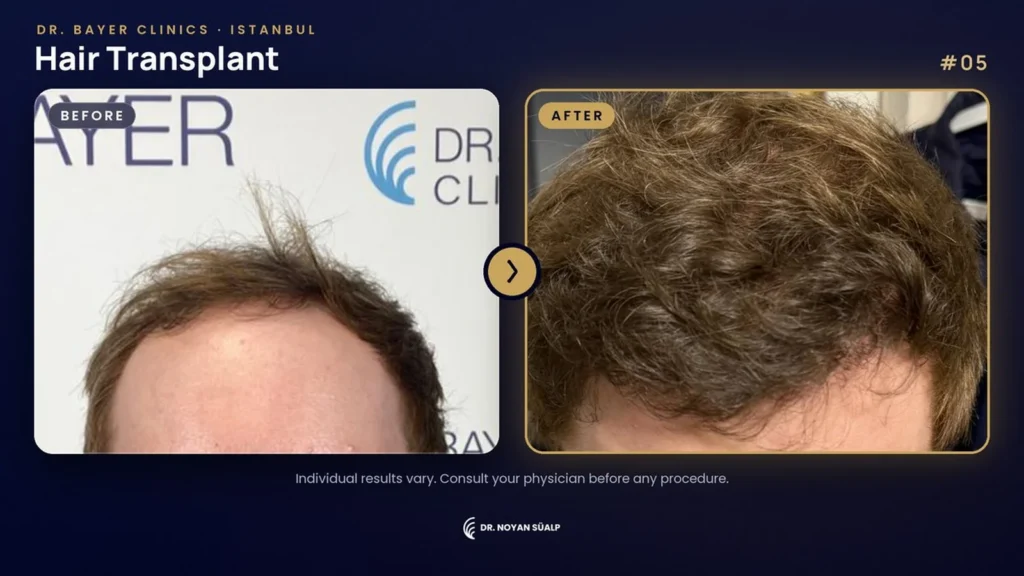

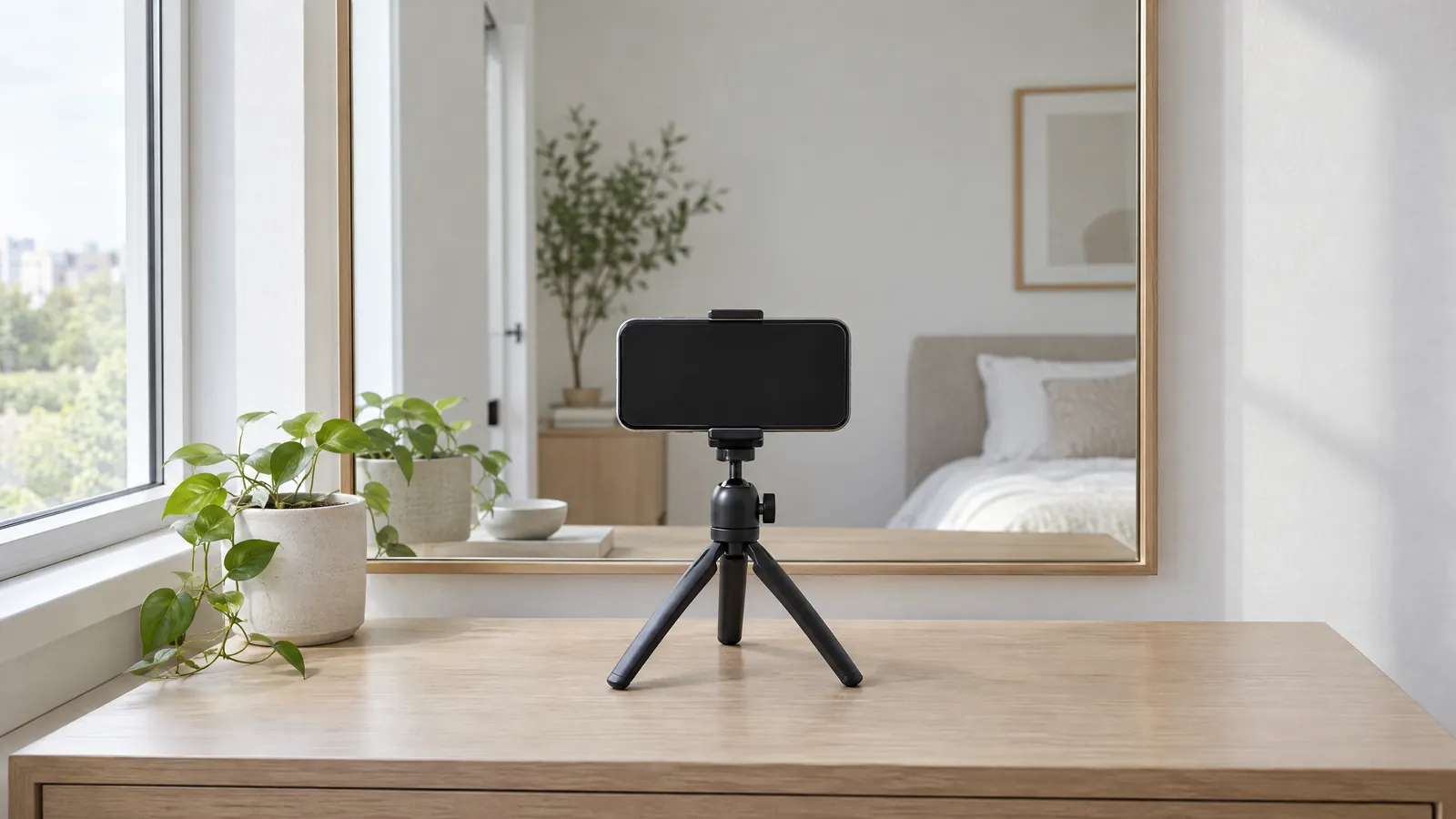
Cover image generated with AI.
For an online hair analysis, five photos are usually enough: the front (hairline), the right and left sides (temples), the top (crown) and the back (donor area). Take them with dry hair, in daylight, without filters and with your phone’s main camera. These photos give the doctor a first impression, but the final plan is only made after an examination in person.
In this guide I explain which photos to send, how to take them, what information to add and what an online assessment can and cannot tell you.
At a glance
- Five core photos: front, right side, left side, crown and back.
- Hair should be dry and clean, with no gel, wax, powder or hair fibres.
- Daylight from a window gives the most even light; avoid strong overhead light and flash.
- Add your age, when your hair loss started and any medicines you use.
- An online analysis is a first assessment; the exact graft number and final plan come after an examination.
What is an online hair analysis?
An online hair analysis is a doctor’s first assessment of your hair based on photos. For people who live in another city or country and are thinking about travelling to Istanbul, it is the natural first step: before you plan a trip, you find out whether a hair transplant is likely to be suitable and which areas would be discussed.
Good photos show a lot; poor photos can make hair look better or worse than it is. Hair research has long stressed the value of standardised photography, meaning the same position, the same lighting and the same distance, for assessing hair. The rules below look simple, but they make a real difference to how accurate an online assessment can be.
The five photos to send
| Photo | What it should show | Common mistake |
|---|---|---|
| 1. Front | The hairline and front of the scalp, with hair combed back | Hair falling over the forehead; camera held too low |
| 2. Right side | The right temple and corner of the hairline | Head turned too far; the ear filling the frame |
| 3. Left side | The left temple and corner of the hairline | Taken from a different distance than the right side |
| 4. Crown | The top of the head and the whorl | Harsh overhead light; blurred photo |
| 5. Back | The back of the head and nape: the donor area | Only the neck in the frame; wet hair |
1. Front: the hairline
Comb your hair back with your fingers or a comb so that the whole hairline is visible. Hold the phone at eye level, about 30 to 40 cm from your face, and look straight at the camera. Your whole face does not need to be in the picture; the hairline and the front of the scalp do. A second photo with your head tilted slightly forward shows density at the front even better.
2 and 3. Sides: the temples
Turn your head about 45 degrees to the right, then to the left, with your hair combed back. Take both photos from the same distance so that the two sides can be compared. Temple recession is often deeper on one side, and only photos of both sides show this.
4. Top: the crown
This one is easier with help. Tilt your head forward slightly and have someone hold the phone about 30 cm above the top of your head. If you are alone, use the timer or video mode in front of a mirror and choose the sharpest frame afterwards.
5. Back: the donor area
The back of the head and the nape are the donor area, where follicles are taken from in a transplant. The doctor looks at how dense the hair is there and how large the usable area is. This photo also works best with help: tilt your head forward slightly and make sure the whole back of the head is in the frame.
Light and camera tips
- Daylight: stand facing a window. Soft, even light shows hair as it really is.
- Avoid overhead light: ceiling lights and bright bathroom spotlights make the scalp shine and hair look thinner.
- No flash: flash creates glare on the scalp and exaggerates contrast.
- No filters or beauty mode: filters smooth hair and change how dense it looks.
- Main camera: use the rear camera at the standard (1x) setting rather than the selfie camera or wide-angle mode, which distorts shape.
- Sharpness: tap the screen to focus on the hair and retake any blurred photos.
How your hair should be
Hair should be dry and clean. Wet hair clumps together and shows more scalp. Do not use gel, wax, mousse, hair powder, hair fibres or coloured sprays: they hide thinning and make assessment harder. Do not cut your hair short or shave it specially for the photos; its natural length also tells the doctor something.
Extra photos for women, beards and eyebrows
Women often notice thinning along the parting and at the front and middle of the scalp. In addition to the five core photos, part your hair in the middle and photograph the parting from above, then move the parting a few centimetres to the side and take a second photo. Leave long hair loose and remove clips, as they can hide thinning. You can read more in hair transplant for women.
For a beard, send photos of your face from the front and both sides, ideally after a few days without shaving, so that the areas where hair does and does not grow are visible. More on beard transplant.
For eyebrows, send close-up photos from the front and both sides without make-up, filler pencil or tint. More on eyebrow transplant.
What to write with your photos
However good the photos are, a short history makes the assessment much more accurate. Please add:
- your age;
- when your hair loss started and how it has changed in recent years;
- whether hair loss runs in your family;
- any medicines you use or have used for hair loss, such as minoxidil or finasteride;
- any previous hair transplant or other procedures;
- long-term health conditions and medicines you take regularly;
- what you would like to achieve and which area bothers you most.
If you have photos from a few years ago, send them too. Older photos show how fast your hair loss is progressing, which is very useful for planning.
What an online analysis can and cannot show
| Can be judged from photos | Needs an examination |
|---|---|
| The pattern and approximate stage of hair loss | Hair calibre and miniaturisation (trichoscopy) |
| Which areas would be discussed | The exact density of the donor area |
| The general appearance of the donor area | The exact number of grafts |
| Whether a transplant is likely to be an option | Scalp conditions and blood tests |
In men the stage of hair loss is often described with the Norwood scale, and in women with the Ludwig scale. Photos give an approximate idea of the stage, but two people at the same stage can need very different plans.
What is assessed in your photos
When a set of photos is reviewed, the first thing to look at is the pattern: hairline and temples, crown, or diffuse thinning. Then the donor area is assessed, because it sets the limits of what a transplant can achieve. If there are signs such as redness, scaling or patchy loss, these should be looked into first. Finally, what you would like is compared with what the photos show. Sometimes the most honest answer is not a transplant now, but medical treatment or waiting first.
Your privacy
Photos of your hair are health information. How they are used and stored is explained in our privacy policy. If you prefer not to show your face, crop the photos above the eyebrows; the hair and scalp are what matter for the assessment.
How to send your photos
You can upload the photos through the online hair analysis form on our home page or send them on WhatsApp. Other ways to reach us are on the contact page. If the doctor asks for more photos, take them under the same conditions so that they can be compared. If you are already planning a procedure, you may find hair transplant day, hour by hour and hair transplant in winter useful.
Frequently Asked Questions
How many photos do I need for an online hair analysis?
Five photos are usually enough: front, right side, left side, crown and back. The doctor may ask for more if needed.
Can I send a video instead of photos?
A short, slow video around the head is helpful, but clear photos are easier to compare, so it is best to send a video in addition to the photos.
Should I shave my head before taking the photos?
No. The natural length of your hair gives the doctor useful information. Just make sure your hair is dry and clean, with no products.
Can an online analysis tell me the exact number of grafts?
Photos give an approximate idea, but the exact number depends on donor density and hair thickness, which can only be confirmed during an examination.
Who sees my photos?
Before you send them, you can ask the clinic who reviews your photos and how long they are kept. How your data is processed is explained in our privacy policy.
Sources
- Canfield D. Photographic documentation of hair growth in androgenetic alopecia. Dermatol Clin. 1996;14(4):713–721. PubMed
- Norwood OT. Male pattern baldness: classification and incidence. South Med J. 1975;68(11):1359–1365. PubMed
- Ludwig E. Classification of the types of androgenetic alopecia (common baldness) occurring in the female sex. Br J Dermatol. 1977;97(3):247–254. PubMed
Further reading: Before and after results · Norwood scale · Hair transplant in Istanbul
Ready to send your photos? Use our online hair analysis form or message us on WhatsApp.
An online analysis is a first assessment and does not replace a medical examination. The final plan is made after an examination. Individual results vary.