
FUE and DHI are the two names you will hear most often when you research a hair transplant. They are often presented as rival methods, but they have more in common than most people expect: in both, the grafts are taken one by one from the donor area in the same way. The real difference is how the grafts are placed into the thinning area.
This guide explains how each technique works, compares them side by side and lists the questions that help you decide which approach suits your hair.
The short answer
- Both FUE and DHI remove follicular units one by one with a tiny punch, usually less than a millimetre wide.
- In FUE, small channels are opened in the recipient area first, and the grafts are then placed into them with fine forceps.
- In DHI, each graft is loaded into a hollow needle (an implanter pen) and implanted directly; the opening is made at the same moment.
- Neither technique is better for everyone. The size of the area, whether you want to avoid shaving and the experience of the team matter more than the name of the method.
What FUE and DHI have in common
FUE stands for follicular unit excision (it is also called follicular unit extraction). Each graft, a natural group of one to four hairs, is cut out of the donor area at the back and sides of the head with a small round punch. This leaves tiny dot-like marks that are usually hidden by short hair once healed. DHI uses exactly the same extraction step.
Both procedures are done under local anaesthesia in a single day, both use the same donor area, and in both the transplanted hair sheds in the first weeks and regrows over about a year. You can follow that process in our hair transplant recovery timeline.
How FUE works
- Extraction: grafts are removed one by one from the donor area and kept in a cooled storage solution.
- Channel opening: the doctor opens small recipient sites in the thinning area with fine blades or needles. The angle, direction and spacing of these channels decide how natural the hairline and the overall result look.
- Placement: the grafts are placed into the channels with fine forceps.
Because all the channels are planned and opened before placement, the design of the whole area can be checked before any graft goes in. This makes FUE efficient for large areas. When the channels are opened with sapphire blades instead of steel ones, the procedure is often called “sapphire FUE”. The rest of the technique is the same. More details are on our FUE hair transplant page.
How DHI works
- Extraction: the same as in FUE.
- Loading: each graft is loaded into the hollow needle of an implanter pen. Several pens are used in turn during the procedure.
- Implantation: the doctor inserts the needle at the chosen angle and depth and releases the graft, so the opening and the placement happen in one movement.
Implanter pens were first described in the early 1990s. They give fine control over the angle and direction of every single graft and make it possible to implant between existing hairs, which is why DHI is often used for densifying thinning areas and for unshaven procedures. Implanting graft by graft takes more time per graft, so very large sessions need a well-coordinated team. Read more on our DHI hair transplant page.
FUE vs DHI: side-by-side comparison
| FUE | DHI | |
|---|---|---|
| Graft removal | One by one with a micro punch | One by one with a micro punch |
| Recipient sites | Opened in advance with fine blades or needles | Created at the moment of implantation |
| Placement tool | Fine forceps | Implanter pen |
| Control of angle and direction | Set when the channels are opened | Set separately for each graft |
| Shaving of the recipient area | Usually shaved | Can often be done without shaving |
| Typical use | Larger areas, front and mid-scalp, crown | Hairline detail, densifying thinning hair, unshaven procedures |
| Time per graft | Faster placement | Slower, graft by graft |
| Healing and growth | Same timeline | Same timeline |
Pros and cons
FUE
- Pros: efficient for large areas; the whole design can be checked before placement; widely used with long-term experience.
- Cons: the recipient area is usually shaved; placement with forceps needs an experienced, careful team.
DHI
- Pros: fine control of every graft’s angle and direction; implanting between existing hairs is easier; often suitable for unshaven procedures.
- Cons: takes longer per graft; requires several pens and a trained team; very large sessions can be long.
Which one is right for you?
The right choice depends on your hair, not on a trend. A doctor will usually consider:
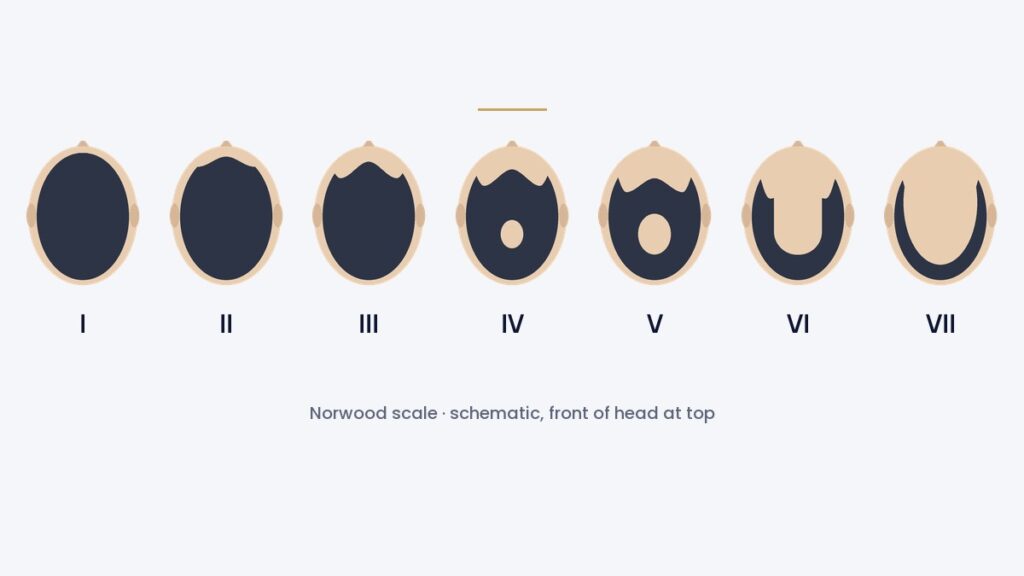
- How large the area is. Extensive loss (for example Norwood stage V or VI) often favours channel-based FUE for most of the area.
- Whether you want to avoid shaving. If keeping your hair long matters, DHI or an unshaven hair transplant may be preferred.
- Whether you are restoring a bald area or densifying thinning hair. Implanting between existing hairs is one of the strengths of implanter pens.
- Your hair characteristics. Curly or very fine hair, and the contrast between hair and skin colour, affect planning in both techniques.
- The team’s experience with each method. A technique done routinely by an experienced team usually matters more than the technique itself.
Some clinics combine both in a single session, for example using channels for the mid-scalp and implanter pens for the hairline. What matters is that the plan is explained to you clearly before the procedure.
Questions to ask before you decide
- Which technique do you recommend for my hair, and why?
- Who will extract the grafts, open the channels and implant them?
- How many grafts are planned, and for which areas?
- Will the recipient area or the donor area need to be shaved?
- What happens if my native hair keeps thinning in the future?
Frequently Asked Questions
Is DHI better than FUE?
Not in general. Both use the same extraction and give the same long-term growth when done well. DHI offers more control per graft and suits unshaven or densifying procedures, while FUE with pre-made channels is efficient for large areas. The best choice depends on your hair and the doctor’s plan.
Which looks more natural, FUE or DHI?
A natural result comes from the design of the hairline, the angle and direction of each graft and the careful handling of grafts. Both techniques can give natural results in experienced hands.
Is DHI more painful than FUE?
Both are done under local anaesthesia, and most patients describe similar discomfort. Most of what you feel is the anaesthetic injections at the start; after that the procedure is usually comfortable.
Which technique has the faster recovery?
Healing is very similar. The scabs fall off in about 10 to 14 days with either method, and the hair grows on the same timeline. The number of grafts and the size of the area have more effect on recovery than the technique.
Can DHI be done without shaving?
Often, yes. Implanter pens make it possible to place grafts between existing hairs, so the recipient area can stay unshaven. The donor area usually still needs to be shaved, at least partly.
What is sapphire FUE?
Sapphire FUE is FUE in which the recipient channels are opened with sapphire blades instead of steel blades. Extraction and placement are the same as in standard FUE.
Can FUE and DHI be combined?
Yes. Some clinics use channels for larger areas and implanter pens for the hairline or for areas with existing hair in the same session.
Sources
- Epstein GK, Epstein J, Nikolic J. Follicular unit excision: current practice and future developments. Facial Plast Surg Clin North Am. 2020;28(2):169–176. PubMed
- Choi YC, Kim JC. Single hair transplantation using the Choi hair transplanter. J Dermatol Surg Oncol. 1992;18(11):945–948. PubMed
- Jimenez F, Alam M, Vogel JE, et al. Hair transplantation: basic overview. J Am Acad Dermatol. 2021;85(4):803–814. PubMed
- Goldin J, Zito PM, Raggio BS. Hair transplantation. In: StatPearls. StatPearls Publishing; 2025. PubMed
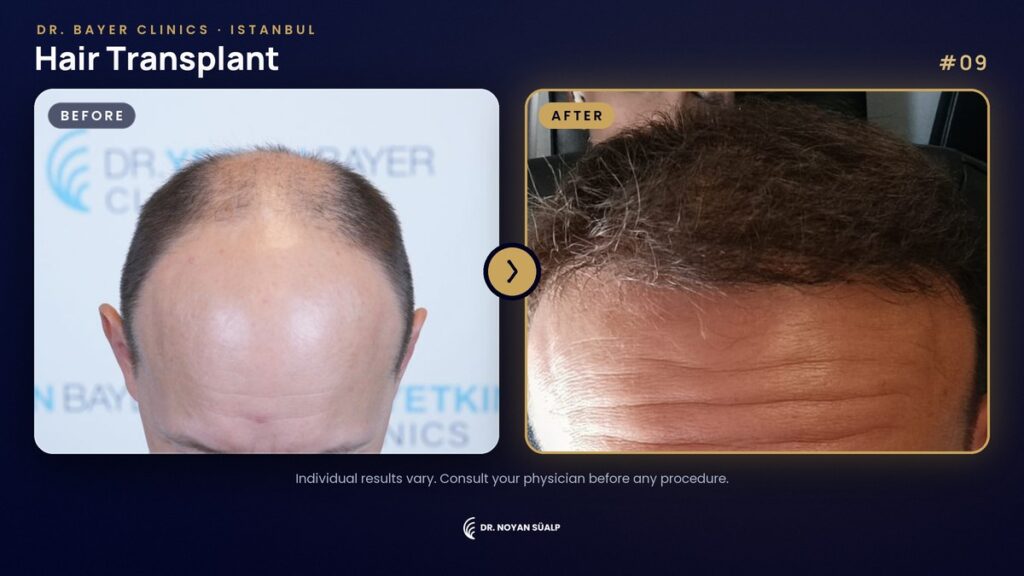
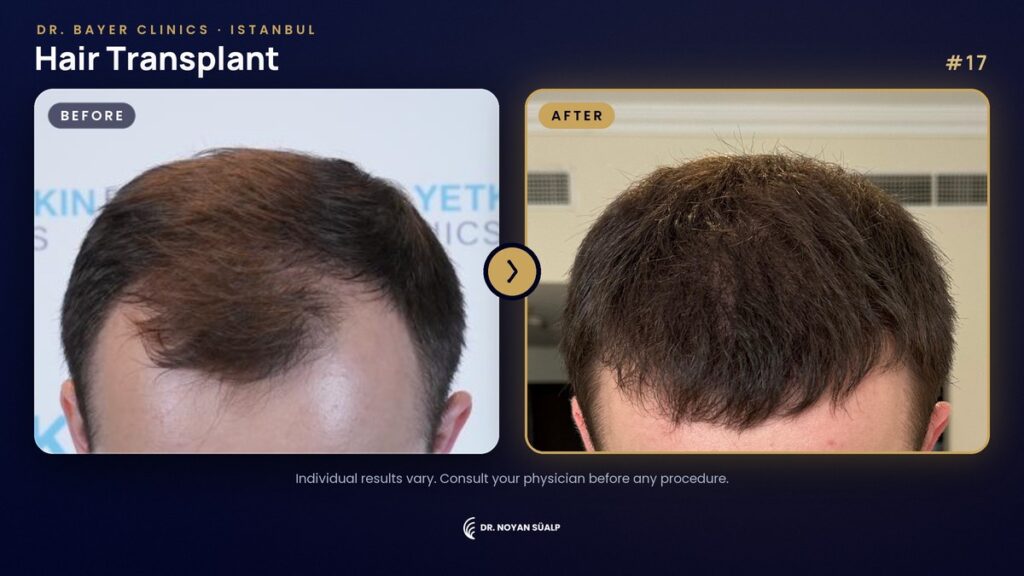
Further reading: Before and after results
Not sure which technique suits you? Send a few photos through our online hair analysis form or message us on WhatsApp, and Dr. Noyan Süalp’s team will explain the options for your hair.
This article is for general information and does not replace a medical examination. Individual results vary.