
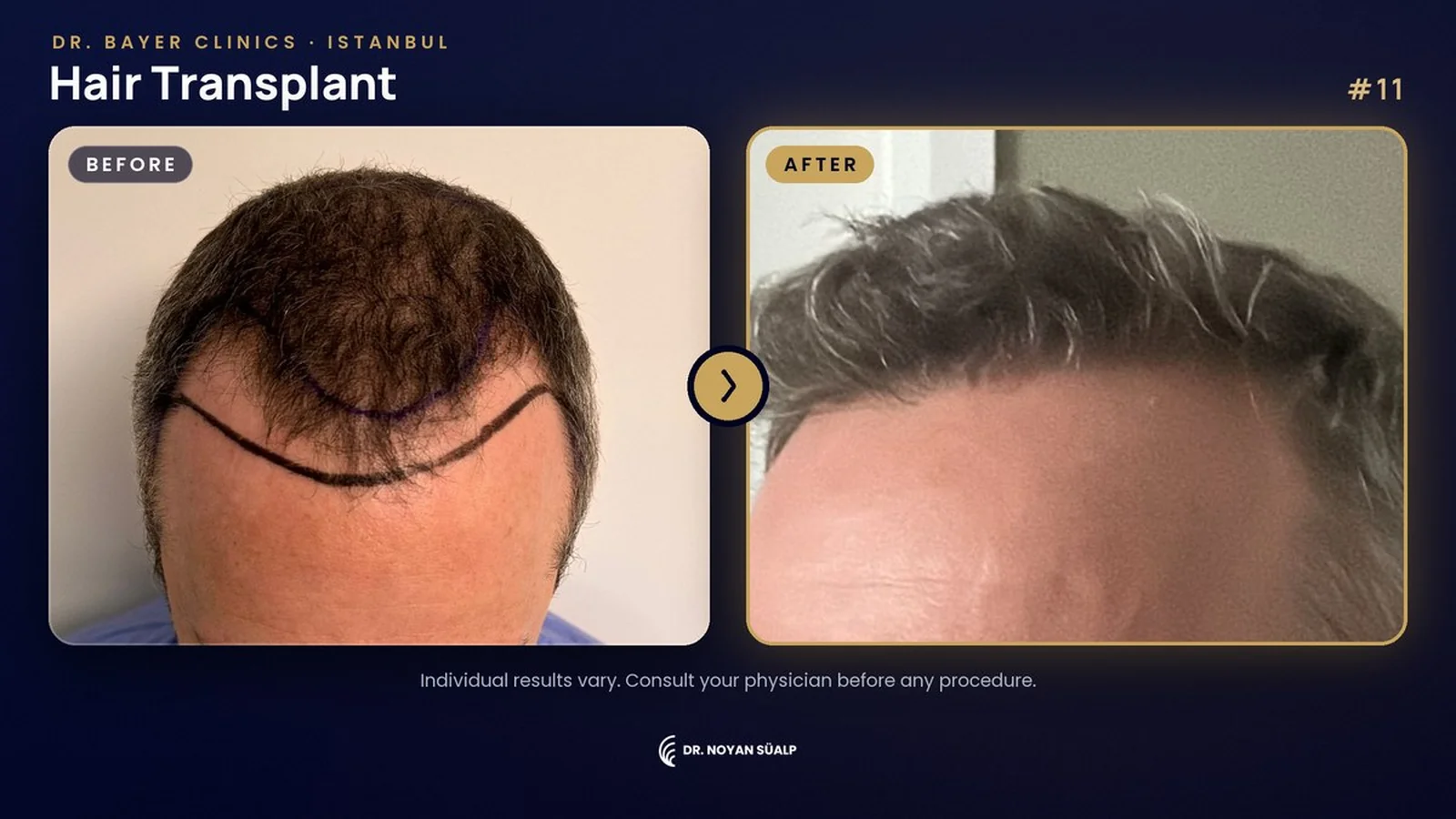
In this case the “before” photo shows the planned hairline drawn on the skin with a marker, and the “after” photo shows the front of the scalp covered with hair along a similar line. It is a useful example of how a hairline plan translates into a result. We only have these two photos, not a month-by-month series, so I comment on what they show and explain in general terms how a result like this develops over the months. Individual results vary.
At a glance
- Area: frontal hairline and temples.
- Before: thinning at the front with receded temples; the planned hairline is marked on the forehead.
- After: the front is covered with hair and the hairline follows a curved, natural-looking line.
- Note: the photos were taken in different places and light, and the hair is longer in the “after” photo.
- The photos are published with the patient’s consent and have not been retouched.
What the photos show
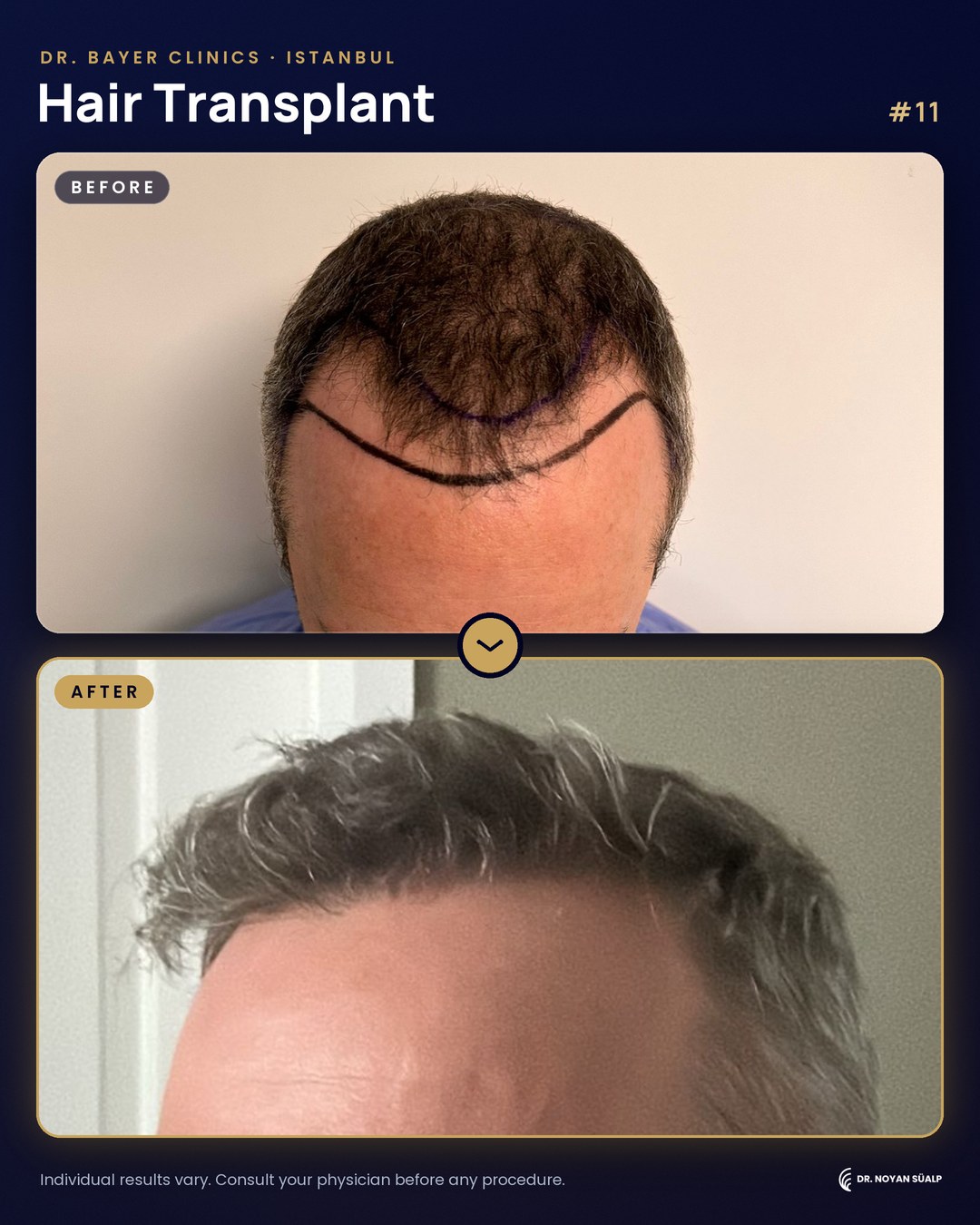
The “before” photo was taken from the front with the head tilted slightly forward. The hair at the front is thin and the temples have receded. A curved line has been drawn across the forehead with a surgical marker: this is the planned position of the new hairline. Drawing the line on the skin and checking it with the patient in the mirror is a standard part of planning.
The “after” photo was taken in a different room. The front of the scalp is covered with hair, the hairline sits roughly where the line was drawn, and it follows a soft curve rather than a straight edge. The hair is longer and styled, and the different light makes it look lighter in colour.
Why the drawn line matters
The marker line in the “before” photo is the most interesting detail of this case. It shows that the result was planned before a single graft was placed. Hairline design generally takes into account the face, age, the expected future course of hair loss and the donor supply, and the line is kept slightly irregular so that it does not look artificial. The patient usually sees the line before the procedure, and it can be adjusted together if needed. You can read more about this in my article on hairline design, which follows later this month.
How a result like this develops, month by month
These two photos do not show the stages in between, but the general course after a hair transplant is well described. The timeline below is typical; individual healing and growth vary.
| Time after the procedure | What usually happens |
|---|---|
| Days 1–14 | Swelling settles, small scabs form and fall off; the drawn line is long gone |
| Weeks 2–8 | Most transplanted hairs shed (“shock loss”); the follicles stay under the skin |
| Months 1–3 | The front often looks similar to before the procedure; redness fades |
| Months 3–4 | New, fine hairs start to appear |
| Months 5–8 | Density builds and the hairs thicken; the change becomes clear in the mirror |
| Months 12–18 | The final result; texture and density settle |
This is why it is best not to judge a result in the first months. The full sequence, with aftercare tips, is in my hair transplant recovery timeline.
What these photos cannot tell us
I do not give a graft number, a hair loss stage or the time between the photos here. These cannot be read reliably from a photograph, and every plan is based on an individual examination. The longer, styled hair in the “after” photo also covers more scalp than short hair would, so the two photos are not taken under identical conditions. That does not make the result less real, but it is worth keeping in mind when you compare cases.
Who this case is not similar to
- people with very advanced hair loss whose donor area cannot cover both the front and the crown;
- people whose donor hair is also thinning;
- women with diffuse thinning, which is planned differently;
- very young patients whose hair loss is still changing quickly, who may be advised to wait.
Whether a plan like this would suit you depends on the factors I describe in am I a good candidate for a hair transplant? For another frontal case, see case 05, and for the procedure itself, hair transplant day, hour by hour.
Frequently Asked Questions
When can I see the final result of a hair transplant?
New hairs usually appear after three to four months, and most of the change is visible between months five and eight. The final result is judged at around twelve to eighteen months.
Is the hairline drawn before the procedure?
Yes. The planned hairline is drawn on the skin with a marker and checked with the patient in the mirror before the procedure starts. It can be adjusted at this stage.
Will my hairline look like the one in this case?
Not necessarily. Every hairline is designed for the person’s face, age, hair type and donor area. A doctor needs to examine you to say what is realistic.
Sources
- Shapiro R, Shapiro P. Hairline design and frontal hairline restoration. Facial Plast Surg Clin North Am. 2013;21(3):351–362. PubMed
- Jimenez F, Alam M, Vogel JE, et al. Hair transplantation: basic overview. J Am Acad Dermatol. 2021;85(4):803–814. PubMed
- Goldin J, Zito PM, Raggio BS. Hair transplantation. In: StatPearls. StatPearls Publishing; 2025. PubMed
Further reading: Before and after results · Recovery timeline · Case 05
Want to know what a planned hairline could look like for you? Send a few photos through our online hair analysis form or message us on WhatsApp.
The photos are published with the patient’s consent and have not been retouched. This article is for general information and does not replace a medical examination. Individual results vary.