
Cover image generated with AI.
A natural hairline is designed, not just filled in. It is usually planned by the doctor together with the patient and drawn on the skin before the procedure, based on the shape of the face, the person’s age, how their hair loss is likely to progress and how much donor hair is available. A natural line is slightly irregular, starts with single-hair grafts, follows the direction in which hair grows at the front and sits at a height that will still look right years later.
In this article I explain the usual steps of hairline design, the common mistakes to avoid and how you can take part in the decision. If you are planning a procedure, ask the clinic who will design and draw your hairline and when you can review it.
At a glance
- The hairline is usually drawn with a marker and checked with the patient in the mirror before the procedure starts.
- Key landmarks are the front point of the hairline, the temple angles and the temporal peaks.
- Natural hairlines are soft and irregular, not straight lines.
- The position has to suit the face as it will look in the future, not only today.
- The donor supply decides how far forward and how dense a hairline can be.
Why the hairline matters so much
The hairline frames the face. It is the first thing people notice and the part of a hair transplant that is hardest to hide if it looks wrong. The medical literature on hair restoration describes the creation of a natural hairline as one of the most important elements of a successful transplant, and the skills involved come down to two things: placing the borders of the hairline correctly and imitating the visual characteristics of a natural hairline with the grafts.
Step 1: listening first
Before any line is drawn, the doctor should ask how you would like to look, which photos of yourself you like and what bothers you most today. Many people bring photos from their early twenties. That is useful, but a hairline from that time is not always the best choice for a face in its thirties or forties.
Step 2: finding the landmarks
- The front point of the hairline: where the hairline sits in the middle of the forehead. Its height is chosen to keep the proportions of the face balanced.
- The temple angles: the corners where the front hairline turns towards the sides. In adult men these corners are usually slightly recessed; filling them completely can look unnatural.
- The temporal peaks: the points of hair in front of the ears at the sides of the forehead. Their position helps the hairline connect naturally with the sides of the head.
- The shape: most natural adult male hairlines are gently curved or slightly bell-shaped rather than flat.
Step 3: thinking about the future
Pattern hair loss can continue behind the transplanted area. A hairline that sits very low and very wide today may later be left in front of a thinning area, which looks unnatural. For that reason the position should still work if the hair behind it thins, and medical treatment to protect native hair is worth discussing where it makes sense. The donor supply also matters: the further forward and wider the hairline, the more grafts it needs, leaving fewer for the area behind it.
A general guide by age
There are no fixed measurements that suit everyone, but the general approach changes with age:
| Age group | General approach | Why |
|---|---|---|
| 20s | Conservative: a mature, slightly higher line with soft temple corners | The final hair loss pattern is often not clear yet |
| 30s–40s | A mature line in proportion with the face; temple corners gently recessed | Balances today’s look with possible future loss |
| 50s and older | A somewhat higher, softer line that suits the face | A very low line can look out of place with an older face |
| Women | Usually rebuilding density behind an existing hairline, or a rounder line | Female hairlines are shaped differently and often preserved |
These are general principles, not rules. The final position should be decided together with the patient after an examination.
Step 4: making it look natural
A natural hairline is not a sharp edge. When you look closely at hair that has never been transplanted, you see a soft transition zone with fine single hairs at the very front, followed by denser groups behind them. A good design tries to recreate that:
- Single-hair grafts at the front, with two- and three-hair grafts placed further back.
- Irregularity: small advances and retreats along the line, so it does not look drawn with a ruler.
- Angle and direction: at the front, hairs grow forward and at a low angle to the skin. If they are placed too steeply, the hairline looks stiff.
- Density gradient: density increases gradually behind the transition zone, which creates the impression of fullness without needing the same density everywhere.
Step 5: drawing and checking together
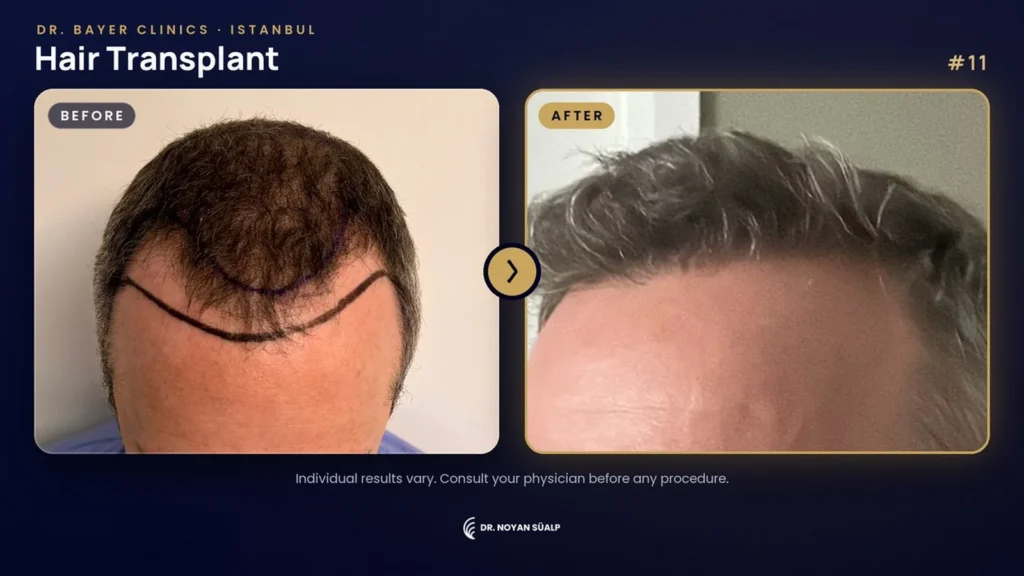
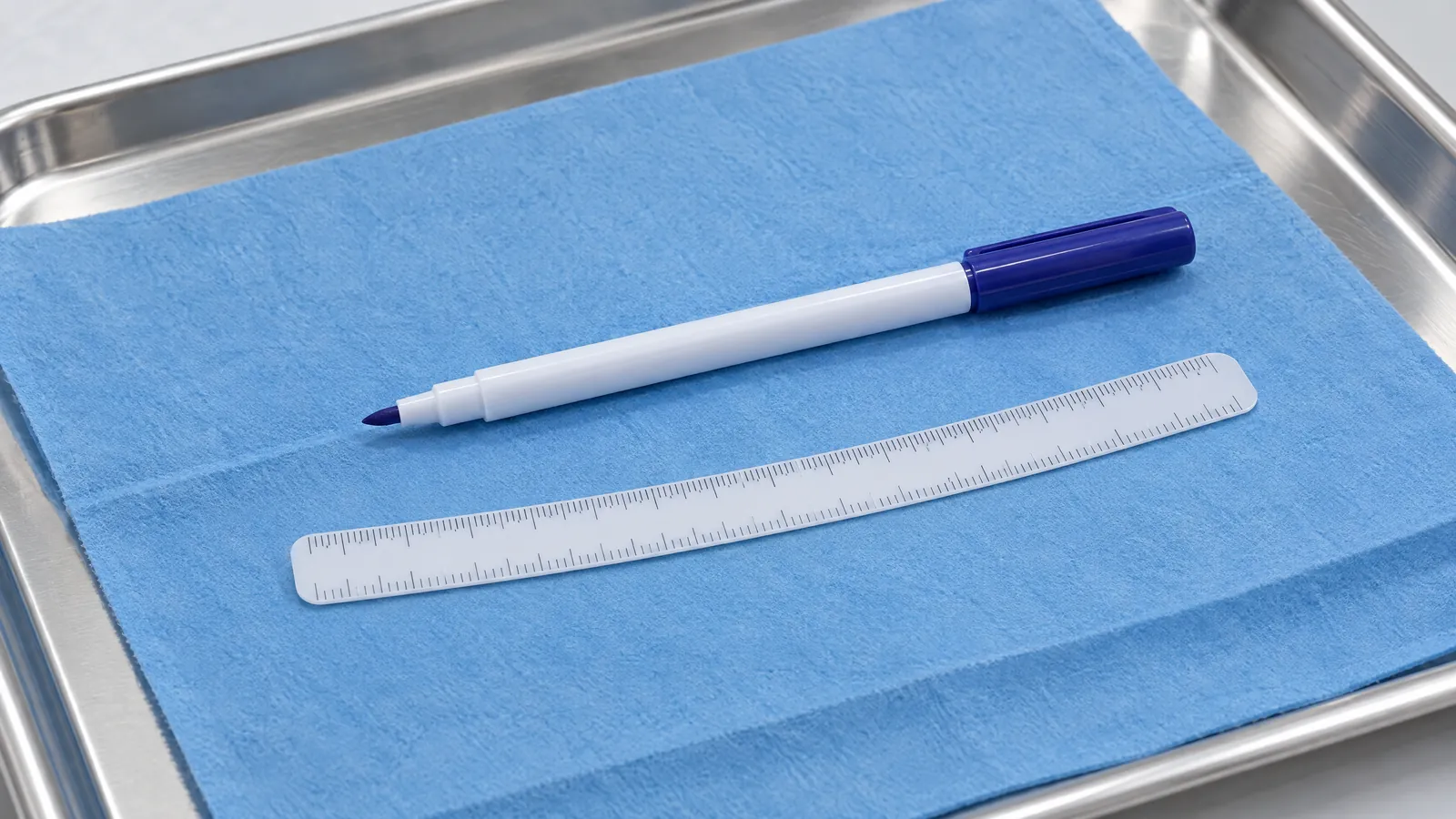
On the day of the procedure the planned hairline is usually drawn on the skin with a surgical marker. You then look at it together with the doctor in the mirror, from the front and from the sides, with the hair combed in different directions. This is the moment to say if you would like it higher, lower or softer. It is much easier to change a marker line than a hairline. You can see an example of a drawn hairline and the later result in case 11.
Common mistakes to avoid
- a hairline that is too low or too straight for the person’s age;
- temple corners filled in completely, which can look like a teenage hairline on an adult face;
- large grafts at the very front, which can look tufted;
- hairs placed at the wrong angle, so they stand up instead of lying forward;
- using too many grafts at the front and leaving too few for the area behind it.
Does the technique change the hairline design?
The design principles are the same for FUE and DHI. What differs is how the grafts are placed. Both can produce a natural hairline in experienced hands, because the result depends mainly on design, graft handling and angle. You can read more on the FUE hair transplant page and in my comparison of FUE vs DHI.
Frequently Asked Questions
Can I choose my own hairline?
You take part in the decision. The doctor should explain what is natural and realistic for your face, age and donor area, and the line is agreed together before the procedure.
Can a hairline be made lower later?
Sometimes it can be adjusted in a second procedure if the donor area allows it. That is why a conservative first design is often the safer choice.
Why are the temple corners not filled in completely?
Most adult men have slightly recessed temple corners. Filling them completely can look unnatural and uses grafts that may be needed elsewhere.
Will my new hairline look natural?
A natural look comes from an age-appropriate position, a soft and irregular transition zone and the correct angle of each hair. These should be planned before the procedure and discussed with you.
Sources
- Shapiro R, Shapiro P. Hairline design and frontal hairline restoration. Facial Plast Surg Clin North Am. 2013;21(3):351–362. PubMed
- Shapiro R. Principles and techniques used to create a natural hairline in surgical hair restoration. Facial Plast Surg Clin North Am. 2004;12(2):201–217. PubMed
- Jimenez F, Vogel JE, Avram M. CME article Part II. Hair transplantation: surgical technique. J Am Acad Dermatol. 2021;85(4):818–829. PubMed
- Avram M, Rogers N. Contemporary hair transplantation. Dermatol Surg. 2009;35(11):1705–1719. PubMed
Further reading: Before and after results · Am I a good candidate? · Case 11
Curious what a hairline design could look like for you? Send a few photos through our online hair analysis form or message us on WhatsApp.
This article is for general information and does not replace a medical examination. Individual results vary.